
This is a painting by Artist Ken Elliot. Surprise! He studied under Wolf Kahn.


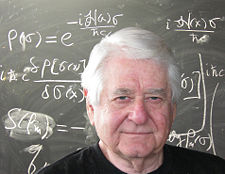
Physicist John Moffatt has a new book out called 'Reinventing Gravity. ' In it, he offers his take on the phenomena of dark matter and dark gravity. According to his theory, working with a variable quantity for the gravitational constant, both phenomena, which have not been observed, are no longer necessary.
Since I'm not a mathematician or physicist, what I found most interesting about the book was Moffat's approach to current assumptions in mainstream science, particularly regarding verifiability and paradigm shifts. His book fairly easy to read, and I haven't gotten to the chapters where he finally spells out his theory, but it appears that he is willing to let observed data have the last say. It will be interesting to see how it all falls out.
Perhaps my favorite part of the book so far is his exposition of the astronomical fascination with the planet Vulcan, a world that was theorized initially, with some authority and even logic, to explain the pertubrations in Mercury's orbit. Moffat likens Vulcan to current theoretization of dark matter.
It is interesting to see scientists grapple with some very fundamental problems in science theory these days. Moffat and Wilczek seem very willing to call things as they see them and not pull any punches.
My own feeling is that the current reliance on symmetry as a guide through today's research will turn out to be overused. It looks as if mathematics itself is in for an overhaul, because our current notation doesn't deal with the dimension of time very well. In simple equations, time is equivocated upon, and Moffat indirectly acknowledges this by refusing to take commutativity as an absolute property of some processes. Another absolute that hasn't been dealt with very well (in my opinion) is pi. This constant is an observed local phenomenon of our particular corner of the universe, and implies a flatness that could easily be violated elsewhere.
Finally, I think the concept of dimension needs to be taken even further than Mandelbrot has carried it, which physicists have implicitly done, but which hasn't made it into our explicit apprehension of the world. Scientists are still relying on Euclidean Geometry of three dimensions for interpretations and explanations of their math, when it is obvious that dimension is the wrong word for what they are calculating.
Dimension is too strongly associated with what we measure as length depth and width, which are entirely Euclidean and simply a construct that ignores other measurable continua in the Universe, such as heat, mass, and others which I might go into at a later date. If we replace the word 'dimension' with 'translation' or some other noun, then an order greater than three or four ('dimensions') becomes intuitively much less confusing.

 Ok. I am fascinated by artists who wear their emotions on their sleeve, because, let's face it, I'm one of them.
 I remember in the late 60's buying a friends Marvelmania mags and a lot of comics to add to my collection. The guy who did Marvelmania was Mark Evanier.

On this day, before one of those days that will be written about, perhaps in history books, I thought it would be appropriate to write about something totally unrelated, as usual.
Did you know that 5 is 0% of 1024? That's how much of my storage space I'm using in this blog.
This is the lie that statistics brings you on your computer desktop.
It is a lie of scale. We live in an age when fractal scaling is all important to our survival, but it is ignored. The miracle of humans is that they can comprehend massive scale discrepancies, as between a universe and a pea.
But in a practical sense, we ignore it. For example, just how many organisms are living on your skin right now? We ignore this gracefully.
This is why, when the computer tells us that 5 is 0% of 1024, our brains flash WRONG. And then we go on with life. But, what are the implications?
If 5 is 0% of 1024, then what is 6?
Something tells me that this is the way the bacteria living on our skins, really want it. Scale, scale is the reality that is invisible to us. How many ppm of mercury is in the fish that you ate last week? Is it 0%?
This, on the day before we will be counting numbers and demanding perfect accuracy. It may mean the end of the world.


My world of solipsism is crashing down around my head. Today I received an actual comment on my ramblings about probability, God, and my lovely nickel standing on its edge. The gist of the comment is that I should stray into rationality, certainly a well meaning and sincere suggestion.
http://plato.stanford.edu/entries/rationality-historicist/
Upon reading this anonymous comment, I immediately found the above site which had some wonderful comments on the historicism of rationality.
Because of the long history of rationality, logic, and the metaphysical basis of both, it is important to realize that these are constructs of human beings, much like the career of Hannah Montana.
In order to correctly discuss rationality, in other words, it is necessary for two or more humans to agree on definitions. It is precisely at the point of this agreement where problems begin.
For example, there is a nice article in Wikipedia about rationality, but a criticism of this article is that it does not cite any authoritative sources. This is a standard criticism found in scientific and scholarly writings. The article above, from the Stanford Encyclopedia of Philosophy, is interesting because it references an important work (to me) by Thomas Kuhn, The Structure of Scientific Revolutions. I highly recommend this series of essays to any student of philosophy and science.
Again, Mr. Kuhn is not without his critics and criticisms, one of which is that his work promotes relativism (a philosophical term, not to be confused with relativity.) Kuhn defends himself in an appendix to his work.
I have no intention of trying to defend or explain any of this, only to say that it is fascinating to find so much disagreement on what many would say is logical and obvious. What Kuhn thoroughly points out, as do others, is that scientific research is full of examples of findings that were anything but obvious, and resulted in views that were fought over, sometimes for years, before any consensus was reached.
If scientific inquiry, possibly the most successful rational undertaking of humankind, is fraught with such disagreement in its development, what can we say of less rigourous categories of knowledge?
Even Mathematics, a field that is based upon logic and proof, is subject to the same disagreements found in the sciences. For an illuminating work that among other things, illustrates such disagreement in mathematics, see George Lakoff's collaboration, "Where Mathematics Comes From".
No doubt there is much to be gained from the rational pursuit of many fields of knowledge.
I thank the commentator for the anonymous comment, and hope that the above assures you that I have not taken rationality lightly. As for my own writings here being pseudointellectual and my having gotten probability wrong, you are probably right.


I've reviewed this book elsewhere, but what I really wanted to talk about was something that Daniel Noel touched upon in 'Seeing Castaneda'.
Reading the latest buzz on Castaneda, he seems pretty much totally discredited as an anthropologist.
However, as an observer or conjurer of human perception and sensibility, he is everything that he said he was. Obviously, given the historical references to his life, the man approached what we consider a cult figure, complete with women who followed him around, something we can easily follow in his books. You might say that he took advantage of his celebrity status and worked back and forth between his books and his followers much as an artist would work with his patrons and audience to popularize himself and his work.
What is fascinating about this approach is that it is self-consistent with the arts of manipulation written about in his books. Furthermore, if we take the incongruency of his writings with what we might call reality or everyday reality, and look at the way society relentlessly renders such incongruencies as superficial or otherwise unworthy of notice, we find even more self-consistency.
Castaneda the faker managed to fake a great many people out for six years. That he is essentially discredited at this time is to miss the whole point of his success at exactly what he claims he was taught by Don Juan. He truly turned writing into an 'act of sorcery' , creating a semiplausible account that was actually taken as the real thing for quite awhile. You might call it nothing more than a 'beautiful hoax' on the level of a fake Vermeer or Piltdown Man, except that Castaneda went much further, actually pointing out what he was doing by having Don Juan point out what he was doing to Carlos.
Which brings us to the Structure of Scientific Revolutions, by Thomas Kuhn. How strange to find almost exactly the permutation of reality that Carlos writes about in a series of essays on scientific experimentation. Now, in no way would I suggest that Kuhn, a scientific historian, is mystical in his approach to the history of science. On the contrary, he exudes careful discernment between the subtleties of concepts he maps out, from paradigms to scientific data. And though he's been accused of being a relativist, I think it would be more accurate to say he's doing something akin to phenomenology here: writing down what he's observed and putting it together as a theory, or thesis.
It softens and relieves pain from sore teats and udders.


klempare - puzzled; at a loss.
Ven sel bachmoorten jidyah mel Borges, corrflink mer peklivaat. Per klempare sel cronicker Tlon.


Or 1986. Days of the Houston Tenneco Marathon. Running to the mall and back on Saturday mornings. There was no poetry, only thirty word essays.
There was no 9-11, we were still thinking about John Lennon getting shot. 2001 was a year in the future, and the Y2K problem wasn't even a gleam in anyone's eye.
Time, as a problem, won't go away. It keeps moving, fluidly.
And the numbers are still in my head.
Hears a piece from much later, to be found in an upcoming book of poetry, Notes From Everywhere.
My backyard considers me
An intruder
An alien
Strange and shuddering
On its infinitesimal world of lumpy earth, a part
Of the whole world.
What if each of us was buried in our backyard? Would the land behave?


 Salvador Dali was struck by the realization that the universe was converging on a railroad station in Perpignan. He was convinced that this confirmed his madness.

In an effort to add meaning to the world, it is my great pleasure to tell you that dividing by zero is now allowed.
(Go Here to see details.)
What's going on? Well, the fact is, you could always divide by zero, just like you could always take the square root of negative one, or subtract 99 from 2. As Tobias Dantzig writes in his monumental book, NUMBER, these two pedestrian operations were once taboo.
No, dear human, the trick is to decide what the operation 1/0 actually entails in terms of math rules. Once these rules are set down and integrated into current theory, division by zero will also become pedestrian.
If you stop and think about it, the majority of human knowledge is legitimized in the same way. There are countless books on the topic, but our point here is that the rules are subject to revision. We need to keep this in mind, both as a caution and an opportunity.
This is why we may someday find that animals are more intelligent than even the ASPCA thinks. If this should happen, books like Cat In the Hat may become Taboo, as unfairly distorting the character of animals. Bugs Bunny may be seen as a slight to the mentally ill, and I don't even want to get into the philosophical issues stirred up by Dr. Doolittle.
For example, Pluto recently became something other than a planet. But not too long ago, Pluto was the name of the God of the underworld, a name that was seldom uttered without fear and trepidation. Now he's just a not-so bright dog, which, again, means watch out for the ASPCA.
Division by Zero as an illegal operation is looked at with the contempt once reserved for cheap trinkets made in Japan, or in my area of the country, mullet. Just read some of the comments at the above link to get a feel for the mindless venom (rattlesnake and spider apology) that humans can spew at ideas. They are protecting their turf, the area of their minds where they were slapped into abandoning illegal math acts.
Will the internet shorten our acceptance time of new concepts?
I doubt it.


If not, perhaps someone could slip in between now and then and mess things up. It's the pop science of the Matrix, isn't it? Ho hum.
Think again. The most interesting feature about discontinuous time is its non-linearity. If this moment is really not connected to the next, then jumps can occur. Certainly our consciousness isn't continuous, as anyone who has ever fallen asleep can tell you.
I remember, as a boy, hearing a song on the radio on summer vacation. Two weeks later the recording was released and I mentioned to someone that it was a great song, I had heard it before. They informed me it was brand new.
Are memories linear? Is the sky blue? It depends on what time you wake up.
 There will be a price to pay, for all your playing around with centrifugal force.

Is there a large sinkhole in your future?
Let's talk about God today. The concept of God, speaking to the atheist hidden away in all of us, is a historical fact. In other words, large masses of people have professed to believe in an unseen higher power of some sort ever since recorded history began.
Even the most ardent atheist has to admit of this as historical fact.
A sincere atheist would examine this fact and have some account for its existence. There are several explanations. To my mind, the most interesting and certainly one of the most explicitly explored was Ayn Rand's view that was outlined in her philosophical works and novels. Rand sincerely wanted to refute the altruistic and mystical aspects of deism, and specifically Christianity.
For my part, having spoken with thousands of individuals about their belief in God or lack of it, what I see is that this personal decision is usually made on emotional grounds rooted in personal experiences. Once the decision is made, only then is it intellectually justified, if ever.
So, I take this as another fact: the decision to believe or not believe in a God is, for the majority of people, an emotional one.
Given these two facts, we find that a great many people in the world are making an emotional decision to believe in a God. This points to the possibility that humans have a strong emotional need to believe in a God. I think this is more than a possibility, I think it is an obvious truth.
I think the emotional basis of that decision is what makes it so much a source of strong interaction between people on both sides of the decision.
But what is even more interesting, if less fundamental, is the way humans take the simple belief or non-belief in a God, and abstract it into complex world-views. Thus we find a multitude of widely different religious systems as well as varying degrees of non-belief, which also have been incorporated into systems.
You can always tell when the decision on belief or disbelief in God is at the core of a world-view. The speaker allows emotion into their argument. This is most evident in scientific and political debate, where name calling and invective often pop up into conversation. I think this is because we emotionally sense that scientific method and unemotional scientific discourse are system-limited to discussion about subjects which are factually provable or disprovable, at least in theory. In other words, they are limited to subjects about which we can observe and verify findings, if not now, then in the foreseeble future.
The further away we get from observable verification, the more that a belief system gains relevance, and the more likely that emotionally based world-views will creep into our discourse. After all, man is a creature that inhabits a body teeming with chemical reactions and complexity. We are wired to have emotions. Which brings me to my final point.
Why are we wired to have emotions? What objective purpose might they serve? On a basic level, they are the source of our physical attraction to the opposite sex which serves to perpetuate our species. We have this in common with most other vertebrates, and can sense and find emotion in the behaviour of our pets, wild animals, etc.
I think that in the more developed species, emotion, or may we say chemical and hormonal processes, are the primary means by which an organism functions and makes life decisions. In fact, a point that was once taken as a universal truth was that the intellectual processing that the human brain accomplishes is a recent addition to our arsenal of life-defending tools.
If we can agree to this, we can perhaps agree that the thinking portion of our brain exists to help us survive in very special situations where our emotional apparatus is deficient. This is a very tricky statement to agree to. It implies that our emotional functioning still serves a useful purpose, which implies that our intellectual functioning is not a complete answer to our ultimate survival, but only an additional refinement to aid in survival.
It seems to me that any capable scientist could explore the above paragraph and devise verifiable experiments to determine more precisely how much our human function depends upon a combination of emotional and intellectual factors, or even if the two have any meaning apart from each other.
Thanks to the internet, we can easily find out if such experiments have been completed or are in process. I leave that to you and me, on our own time.

There is a very real possibility that we have all been fooled. You can test this by eating a piece of cheddar cheese and a fresh strawberry at the same time. Very few people are brave enough to try this.

 We sometimes have to take things seriously, as when the icecaps are melting.


0127_04.jpg)


